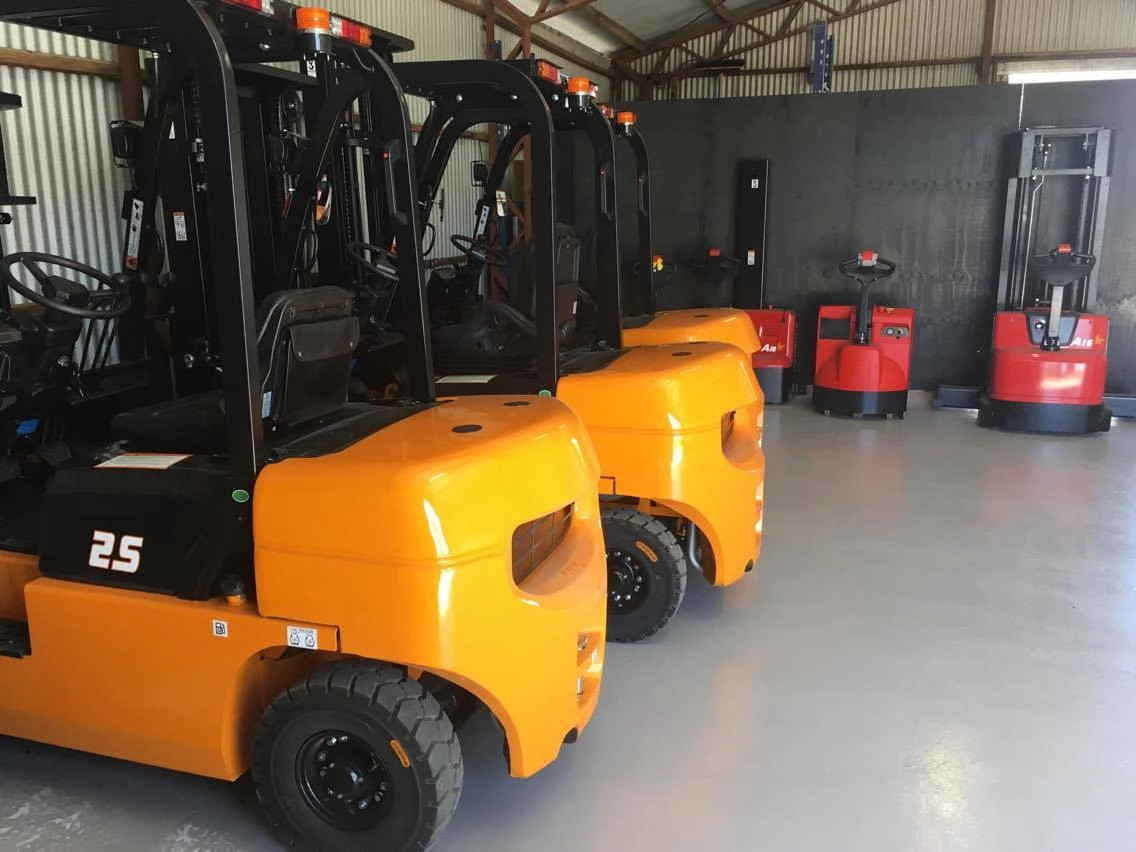
1. What Type of Forklift Best Fits What My Business Needs?
The first question isn’t about budget it’s about purpose. What you need your forklift to do will determine almost everything else, from fuel type to lift height.
If you’re working indoors in a warehouse or distribution center, an electric forklift might be the smart choice. They’re quieter, emission-free, and can maneuvers well in tight aisles.
But if you’re moving heavy loads across dirt or gravel yards, you’ll probably need a rough terrain forklift with serious ground clearance and pneumatic tires.
There’s also a middle ground LPG/petrol forklifts which can handle both indoor and outdoor work if your facility has good ventilation.
2. How Much Weight Will I Be Lifting?
The catch? Many buyers only consider their heaviest current load not what might come down the line. If your contracts or inventory could change, it’s safer to give yourself some breathing room in capacity.
It’s also worth noting that a forklift’s maximum lift height can affect capacity. The higher you raise a load, the more stability matters, and the less total weight you can safely handle. Always check the load chart for your exact lift height needs.
3. What Terrain and Space Constraints Will I Face?
A forklift that looks perfect on paper might be a nightmare to use if it’s not built for your conditions.
- Will I be driving on smooth concrete floors or uneven outdoor surfaces?
- Are there ramps, loading docks, or inclines to deal with?
- How wide are my aisles and turning spaces?
Electric and LPG forklifts usually excel indoors and on smooth surfaces, while rough terrain forklifts are designed for outdoor yards, construction sites, and farms. If you’ve got a mix of both, you may need to balance tire choice, clearance, and maneuverability.
4. What Are the Total Costs Beyond the Price Tag?
It’s tempting to focus only on the purchase price, but that’s just one part of the total cost of ownership.
Over the life of a forklift, fuel, maintenance, parts, and downtime can easily outweigh the initial investment.
For example, electric forklifts might cost more upfront but save money on fuel and have fewer moving parts to maintain. Diesel or LPG models may be cheaper to buy but can rack up higher fuel and servicing bills over time.
Also consider how quickly you can get parts, how easy it is to find qualified service technicians, and whether your dealer offers warranties or maintenance plans.
Why These Questions Matter
Skipping these questions is like signing a lease on a building without checking if it has enough power for your equipment.
Sure, you might get lucky but more often than not, you’ll run into avoidable problems.
- Handle your loads with ease.
- Navigate your workspace efficiently.
- Stay reliable with manageable running costs.
How to Put This Into Action
- List every task your forklift will need to perform.
- Measure your space aisle widths, door heights, ramp gradients.
- Identify your heaviest and most awkward loads—and plan for growth.
- Compare running costs, not just purchase prices.
If you can’t answer any of these questions yourself, talk to a forklift dealer who’s willing to visit your site and make recommendations based on real conditions.
Choose the Right Forklift to Keep Your Business Moving
The forklift you choose can make or break your productivity.
By asking the right questions before buying, you protect your investment, improve safety, and ensure your machine fits your work environment perfectly.
Find Your Forklift Today
Ready to explore a full range of forklifts for sale in Southeast Queensland?
Browse our complete selection and get expert advice to help you choose the perfect fit for your business.