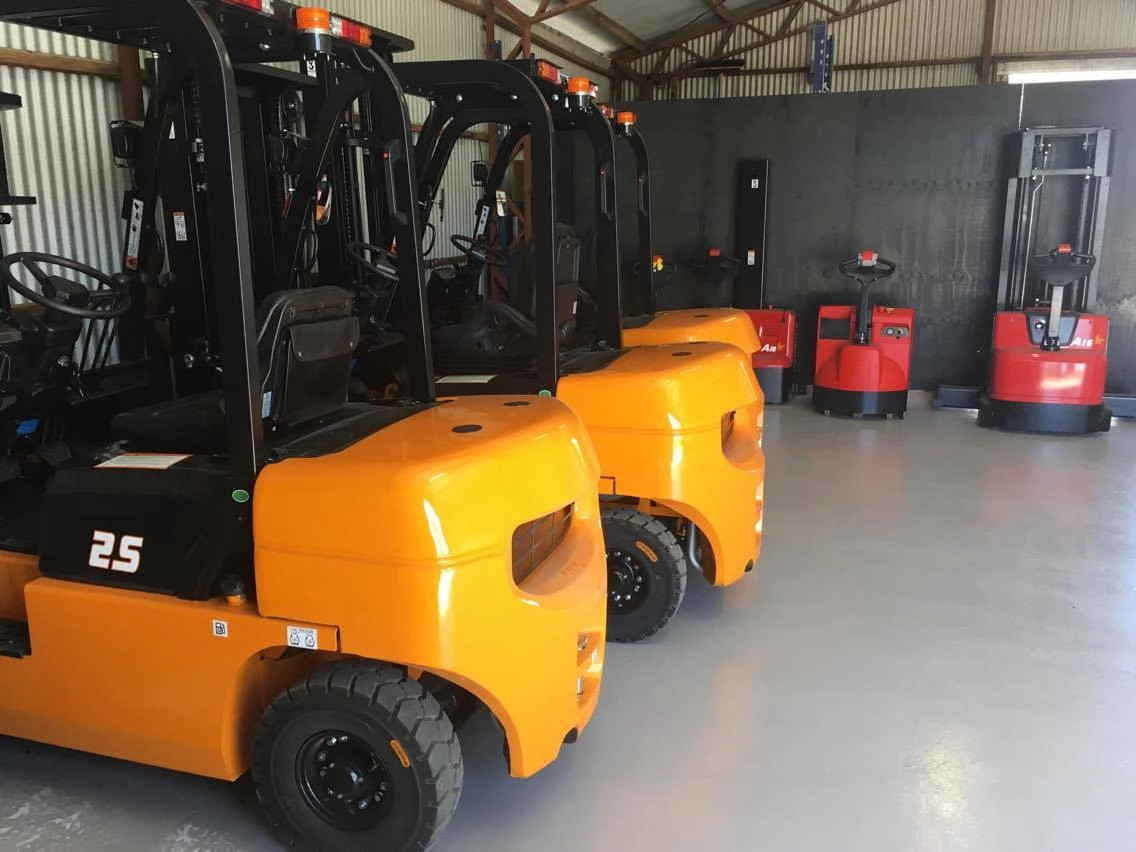
If you have ever compared forklifts online and felt like every machine starts sounding the same after a while, you are not alone.
The counterbalance vs reach forklift question trips up a lot of buyers across Brisbane and Southeast Queensland because both machines move pallets, both live around warehouses, and both look like they should handle similar work.
But in real life, they are built for very different jobs.
Choose the right one and your operation feels smoother from day one. Choose the wrong one and you end up fighting your own layout, your own racking, and your own loading areas every shift.
Here is the simple version of what each machine does best and how to work out which forklift suits your site.
Why This Choice Confuses So Many Buyers
On paper, both forklifts lift loads, move pallets, and help keep goods flowing.
That is where the similarity ends.
A counterbalance forklift is the all-rounder most people picture when they hear the word forklift. It carries the load out front and uses weight at the back of the machine to balance it.
A reach truck is designed more like a warehouse specialist. It is built to work in tighter aisles and reach up into high racking with more precision.
So when people search counterbalance vs reach forklift or reach truck vs counterbalance, what they are really asking is this:
Which machine fits the way my business actually works?
That is the question that matters.
What A Counterbalance Forklift Does Best
A counterbalance forklift is usually the go-to machine when your work happens around loading docks, yards, general warehouse spaces, and trucks coming in and out all day.
It is called a counterbalance because the weight at the back offsets the load carried on the forks at the front. That design keeps the machine simple, strong, and versatile.
For many businesses in Brisbane, Ipswich, Toowoomba, and the wider Southeast Queensland region, this is the forklift that handles the bulk of everyday work.
A counterbalance forklift usually makes more sense when you need to:
- unload pallets from trucks or containers
- move stock between indoor and outdoor areas
- work in open warehouse aisles rather than very narrow racking lanes
- handle general loading dock tasks quickly and repeatedly
- use one machine across a mix of tasks instead of one specialised job
If your team is regularly receiving deliveries, loading outbound trucks, or working in spaces where turning room is not especially tight, a counterbalance forklift is often the safer bet.
It is also the machine many buyers choose when they want a practical starting point and are still working out exactly how specialised their next forklift needs to be.
Where A Reach Truck Makes More Sense
A reach truck is built for a different kind of environment.
This machine shines in tighter warehouse layouts where storage density matters and the real challenge is not just moving stock, but reaching it safely and efficiently at height.
In simple terms, a reach truck is made for aisles where space is tight and racking is high.
That is why they are common in modern warehousing, cold storage, distribution centres, and sites where every square metre of floor space needs to work hard.
A reach truck usually makes more sense when you need to:
- work in narrow aisles
- lift pallets into high racking
- maximise warehouse storage capacity
- move mostly on smooth indoor floors
- do repeated putaway and retrieval work rather than outdoor transport
If you are pulling pallets from 8 metre racking in a cold store, a reach truck is your machine.
If you are trying to squeeze more storage into an existing warehouse without moving premises, it is often the better answer than trying to make a bigger general-purpose forklift do a specialist warehouse job.
Reach Truck Vs Counterbalance In Real World Scenarios
This is where the decision gets much easier.
Forget the brochure language for a moment and picture what your team actually does across a normal day.
If you are unloading containers from a truck, staging pallets near a dock, and moving stock between a warehouse and an outdoor hardstand, you usually want a counterbalance forklift.
It is better suited to loading dock work, general transport, and mixed-use environments where the machine needs room to move and the job changes throughout the day.
If your operators spend most of their time inside a warehouse, weaving through narrow aisles and pulling pallets in and out of tall racking, you are usually looking at a reach truck.
That is where the machine earns its keep.
A simple way to think about it is this:
Counterbalance forklifts move stock across your operation.
Reach trucks help you use your warehouse space better.
Both are valuable. They just solve different problems.
Which Forklift Do I Need For My Site
If you are asking which forklift do I need, start with five practical questions.
First, where does most of the work happen?
If the answer is outdoors, around loading docks, or in mixed environments, a counterbalance forklift is usually the better fit.
If the answer is almost entirely indoors on smooth floors, a reach truck becomes more attractive.
Second, how tight are your aisles?
A reach truck is designed for narrow aisle work. A counterbalance forklift needs more turning space.
Third, how high are you lifting?
If your warehouse relies on high racking, reach trucks have a clear advantage.
Fourth, what matters more right now, versatility or storage efficiency?
If you want one machine that can cover a wider range of everyday tasks, counterbalance often wins.
If you want to increase storage density and work more efficiently in racking, reach usually wins.
Fifth, are you moving pallets over distance or mostly storing and retrieving them?
That answer tells you a lot.
For many operations, the decision is less about one forklift being better overall and more about which one matches the bottleneck in the business.
Common Mistakes Buyers Make
One common mistake is choosing a forklift based on familiarity instead of layout.
A business might buy another counterbalance forklift simply because that is what they have always used, even though the warehouse has changed and storage is getting tighter.
Another mistake is buying a reach truck because high racking looks impressive on paper, even though the site spends half the day unloading trucks and moving stock outside.
That is when the machine starts feeling frustrating instead of helpful.
The best forklift buyer guide Queensland businesses can follow is not complicated.
Match the machine to:
- the layout of your site
- the height of your storage
- the width of your aisles
- where the work happens most often
- how stock actually flows through the business
When you get those basics right, the decision becomes far less confusing.
The Smart Answer For Many Businesses
Some businesses in Southeast Queensland do not need to choose one forever.
They need to choose what solves the biggest problem first.
If your current issue is truck unloading, outdoor movement, and general flexibility, start with a counterbalance forklift.
If your issue is that your warehouse is running out of room and your team is constantly fighting narrow aisles and high racking, a reach truck may deliver more value straight away.
And if your operation does a bit of both, the right answer might be a mix of machines rather than trying to force one forklift to handle every job on site.
That is usually where honest advice from an experienced forklift supplier helps most.
Frequently Asked Questions
Is A Reach Truck The Same As A Counterbalance Forklift
No. A reach truck is a specialist warehouse machine designed for narrow aisles and higher racking, while a counterbalance forklift is a more general-purpose machine suited to loading docks, open spaces, and mixed indoor-outdoor work.
Which Is Better For A Warehouse
It depends on the warehouse layout.
If you have narrow aisles and high racking, a reach truck is usually the better choice. If you have wider aisles, regular truck unloading, or more general materials handling tasks, a counterbalance forklift may suit your warehouse better.
Can A Counterbalance Forklift Work In Racking
Yes, but it depends on aisle width, lift height, and the type of storage system you use.
A counterbalance forklift can work with racking in many warehouses, but it is not as efficient as a reach truck in narrow aisle, high-density storage environments.
Is A Reach Truck Only For Indoor Use
In most cases, yes.
Reach trucks are best on smooth indoor warehouse floors where they can operate safely and precisely. They are not the first choice for outdoor yards, uneven ground, or loading dock work.
What If My Business Needs Both Functions
That is common.
Many businesses use a counterbalance forklift for unloading and outdoor movement, then use a reach truck inside the warehouse for racking work. If your operation covers both tasks regularly, a mixed fleet can make more sense than trying to compromise with one machine.
Ready To Find The Right Machine For Your Operation
If you are still weighing up counterbalance vs reach forklift options, the easiest next step is to look at the kind of work your site does every day and match the machine to that.
At Eagle Forklifts, we help businesses across Brisbane and Southeast Queensland choose forklifts that suit their actual operation, not just what sounds good in a product description.
Ready to find the right machine for your operation? Browse Eagle Forklifts’ full range and compare the options that make sense for your site.